
The First Emperor of Qin was one of the most powerful people of his time. He conquered all of China, combining the warring states but was obsessed with taking an army for protection into the afterlife with him. 700,000 men built his tomb and an army of many thousands made from terra-cotta (unglazed clay, to make them more durable). These warriors were discovered in 1974 when some farmers were getting water from a well. Crowds flocked to see this terra-cotta army of very intricate and majestic figures holding commonly used weapons, like the crossbow, dagger-axe, and arrowheads and bronze artifacts. “Why was it done?”. The Emperor wanted his army to be by his side forever, in spirit. It was done utilizing the abundance of resources that China had. Another show of the Emperor’s power were the plans to make his tomb even better after transitioning from king to emperor. The actual tomb has been covered by bushes and trees, but looters and high-ranking officials have broken into the adjoining tomb that didn’t contain the Emperor. This tomb contained most of the emperor’s belongings and many artifacts and rare specimens as well as the terra-cotta army. The construction of the tomb meant putting a greater importance on the Emperor even after his death.
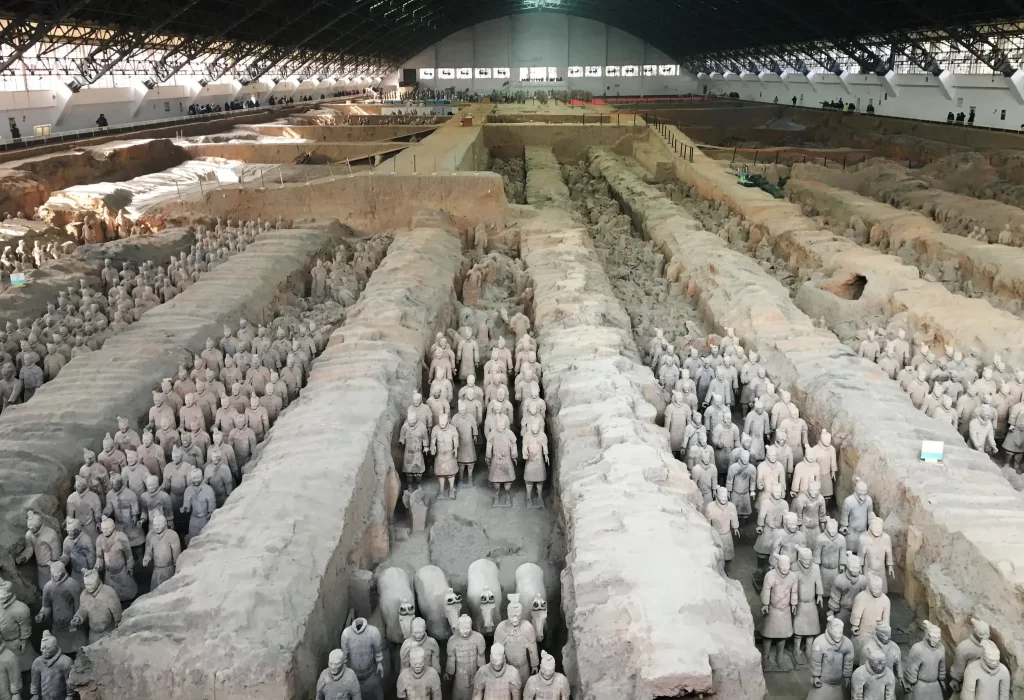
Xian Offers Terracotta Warriors, Stunning Food and Plenty of Bargains – New York Times
The Qin were ruthless, which made them very successful in deploying mass infantry, armies of several hundred thousand soldiers who were recruited from the lower class and the terra-cotta army is a model and homage to the Qin’s superior military organization.
Why were they buried underground and why were they made from terra-cotta? Royal tombs were a priority for the Chinese and they were willing to spend an endless amount of money and labor building enormous tombs for their rulers. The terra-cotta was a practical decision. It wasn’t as valuable as bronze, the material was durable and could get wet without being ruined, and it didn’t require killing actual soldiers, which would be a waste of resources. The First Emperor was a cruel ruler though and ordered that all the artisans and workers had to be imprisoned in his grave after they finished their work.
Finally, the amazing number of different looking figures was a spectacular feat. All the parts of the warrior army were made in “modules” so that different faces, ears, hands, feet, and bodies could be combined to make many diverse warriors. There are now street walls against the interior tombs because they opened one in the 1950s and everything that was inside got corroded by oxygen. Now they are waiting to dig up or open anything else here because they haven’t figured out how to protect the very old materials from disintegrating when exposed to the air and the pollutants after being buried for thousands of years. It must be torture to know there is more to dig up and learn about and have to put it all on hold!
Bibliography
Slides (Gdrive link)
Ledderose, Lothar. Ten Thousand Things : Module and Mass Production in Chinese Art.
The A.W. Mellon Lectures in the Fine Arts, 1998. Princeton, NJ: Princeton
University Press, 2000.
Peterson, Lucas. “Xian Offers Terracotta Warriors, Stunning Food and Plenty of
Bargains.” The New York Times, The New York Times, 23 Feb. 2018,
