
The reading “Chinese Money in Global Context” compares the development and usage of money in the Roman Empire to China. The breakup of the Eastern Han Empire and the division of China that followed did not affect the country monetarily as drastically as the fall of the Roman Empire did to Europe when Roman gold coinage disappeared. A long history of monetary advances put China’s use of the banknote five centuries ahead of Europe and the Middle East. Because there was a weaker central government, “private coinage” spread and once in the private sector, the technology of casting improved considerably. It is interesting that emperors didn’t appear on coins because they didn’t want to reveal themselves to their people. As the Northern Song armies were taking power in Sichuan, the iron currency was too heavy and inconvenient, so the coins were deposited in return for promissory notes, which was the root of the world’s first paper money. China began to struggle with coin famines, which they attributed to overseas demand and overpopulation, and at that point new higher value coins made from gold and silver were issued along with more paper notes, backed by revenue from the salt trade.
This week, I read “Money on the Silk Road” from exploration pack 1. The first major coin type in China was the “wuzhu” coin, which lasted for over 700 years. However, identification of this coin was inconsistent and it was hard to tell between official and unofficial coins so they served very little purpose archaeologically. Also, there were too many coins at any one site, meaning archaeologists and historians did not have enough funding to clean, record, and study all of them. Coins were used in the afterlife and were placed in tombs with the dead. The Chinese coin symbolized some philosophies; yin and yang and the Five Directions (North, South, East, West, and Center), which popularized the grouping of things of five.
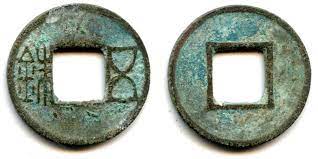
Chinese coins were usually copper – sometimes gold and silver (if special-purpose) – with a square hole in the middle and an inscription. During the Qin dynasty, Banliang coins were used. Though after the Qin fell and the Han rose, people were allowed to have coins appropriate for them as individuals. Eventually, Banlian was used as the official currency under the Han. Later, the wuzhu coin became popular. When the Tang came into power, they abolished the wuzhu and introduced the Kaiyuan tongbao. In between the Han and Tang dynasties, grain and textiles were adopted as currency, as well as coins.
Bibliography
Horesh, Niv. Chinese Money in Global Context: Historic Junctures between 600 BCE
and 2012. Stanford, California: Stanford University Press, 2014.
Wang, Helen. Money on the Silk Road: The Evidence from Eastern Central Asia to c.
AD 800. London: British Museum Press, 2004.
