
On Tuesday, I chose to read the chapter about space (chapter 2). I have always wondered about the courtyard part of Chinese homes. The homes featured in the chapter were in Zhejiang and many of the decisions that the builders made were based on the climate there. Zhejiang is south – the summers are longer and the winters fairly warm, so the builders blocked the sun by using fewer windows, houses that were deep instead of wide, and thick white walls that reflected the sun rather than absorbing it, all to keep the heat out. It amazed me that so long ago, the Chinese figured out how to make their homes thermally efficient. They also built their houses very close to each other to take advantage of shade from nearby houses and they built steeply pitched roofs to deflect the heavy summer rains.
The houses were also built based on uniform sized rectangular units called jian, which were all the same size depending on the area. Depending on the size of the house, the layout was a number of jian – it was always an odd number because odd numbers represented good luck. It was a smart system that made the houses more structurally sound and easier to add on to as families grew.
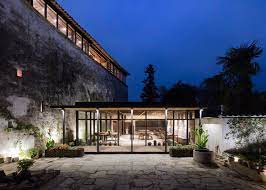
Because most of the houses in Zhejiang were not large, there wasn’t as much space for courtyards (also called skywells) as there was in the North, but they all had a skywell. The chapter showed drawings and pictures of larger northern homes with courtyards. They bring the indoors and the outdoors together within the house and provide a gathering space for the extended families who all lived together. The Yin Yu Tang house virtual tour had an amazing courtyard with two pools fed by underground springs.
After reading the “Forty Scenes” and the “Twenty Views of the European Palace”, I found it interesting that in 1783, the emperor had commissioned engravings that embodied Western and Chinese style. The art was beautiful and in class on Thursday, I learned that it was common to include some form of western style in Chinese art – like an emperor wearing western clothing in a painting.
Bibliography
Knapp, Ronald G. China’s Vernacular Architecture: House Form and Culture.
Honolulu: University of Hawaii Press, 1989
https://www.pem.org/visit/yin-yu-tang/yin-yu-tang-tour
“Forty Scenes” and “Twenty views of the European Palaces”
