
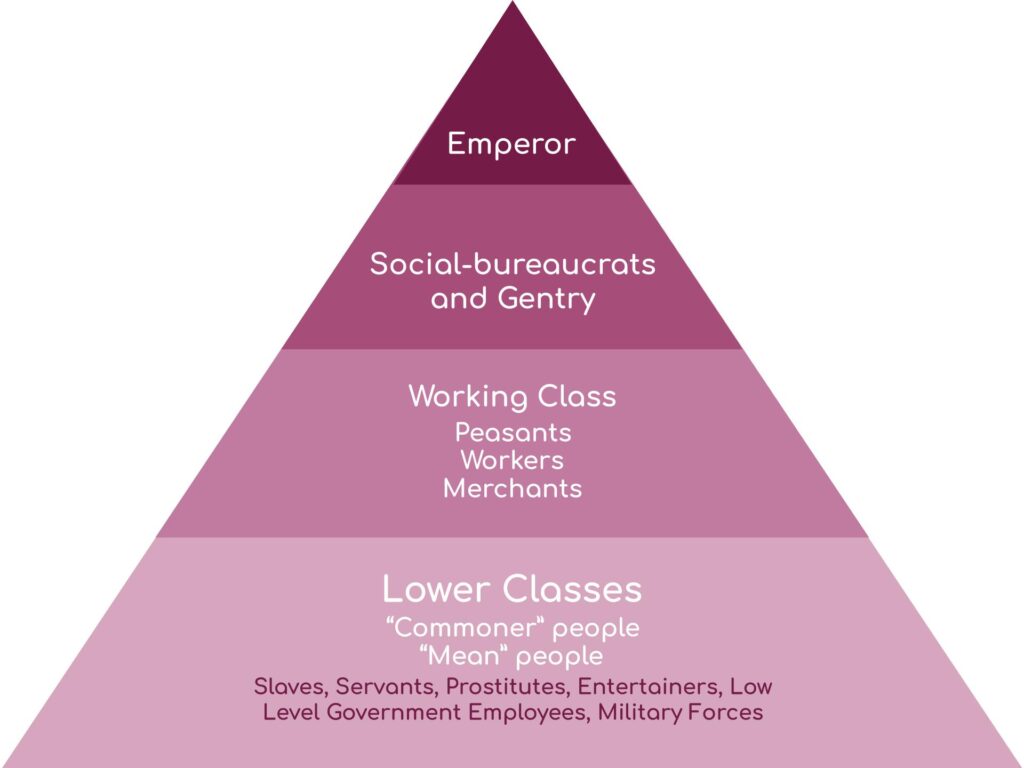
Artisans are at the bottom of Imperial China’s caste system
Artisans in early imperial China were surprisingly not revered for their skill and artistry and were seen as lower class and commoners who were tolerated. They were skilled workers in their craft (metalworking, ceramics, textiles, and woodworking) and were valued for their expertise and contribution to society but they didn’t hold high social status or political power. Though artisans were in guilds and their own hierarchies, they were still subordinate to the ruling class and weren’t able to move up in society’s caste. Artisans trained apprentices to pass on and preserve their knowledge and skill.
Artisans have been used, by philosophers, in illustrations of moral and philosophical concepts. Confucius once said “If an artisan wants to be good at his craft, he must first make sharp his tools”. This was an analogy to how individuals should be good human beings by practicing benevolence and propriety. Learning to become an exemplary human being are like artisans who must be prepared and can’t succeed without proper tools and training. Just as it is important for an artisan to sharpen his tools, it is imperative that one must establish friendships with those who practice benevolence. There is little evidence of the creative process of real artisans in early imperial China, which is why philosophers’ analogies are used to draw conclusions. Techniques were not recorded because even if the artisans themselves were literate, the processes were family secrets and guaranteed their livelihood, so writing them down would have been too risky.
During class, we talked about flow and focus because that is part of an artisan’s creative process. Part of this discussion was thinking about a time that I created something with extreme focus and clarity of purpose. I remembered when I would play soccer with my team in high school. When I was out on the field, I wouldn’t give much thought to what I was doing because my instincts had been honed by hours and hours of practice. I always had to make decisions quickly and I would be in the zone, playing by my instincts.
Bibliography
Barbieri-Low, Anthony J. Artisans in Early Imperial China. Seattle: University of
Washington Press, 2007
