
This week, I chose the Oracle Bones Exploration Pack.
The Shang Dynasty, from 1600 to 1200 BCE, is considered to be the first recorded Chinese dynasty. Studying the Shang Dynasty is important because it helps to understand the development of the political, social and cultural aspects of Chinese civilization. The practice of bone cracking was used by the Shang to communicate with their ancestors and deities through the use of oracle bones which were inscribed with questions and then heated until they cracked. These bones were not discovered in China until 1899. Before that point, the Chinese called them Dragon bones and had been grinding them up for use in medicines. The discovery of their importance put an end to that practice. Up until the late 1800s, there was no proof that the Shang Dynasties and stories of people’s wealth, occupations, trade and culture had existed except for stories passed down. These inscribed bones finally provided proof. The writing of texts in China began as early as the reign of King Wu Ding during the Shang Dynasty, from the years 1250 to 1200 B.C.E. The process of recording something in writing was very intricate. These texts consisted of inscriptions made on turtle shells and animal bones, which were used for predicting the future (like whether there will be a good harvest, war, childbirth, weather…) by the Shang dynasty rulers. Then people would interpret the meanings of each crack accompanied by rituals with music, dancing, and sacrifice. Many of the inscriptions were about what the king should do. A hot poker was applied to the shell or bone and the resulting cracks were interpreted as to whether it was meaningful or not to the question. The questions asked give insight into the concerns of the wealthy and how the elite society of the Shang spent their time. Because the bones were dated, historians have information about when cities were built, taxes paid, animals were sold, marriages planned or the timing of astronomical events. The poor couldn’t afford to consult the oracle and didn’t have the opportunity to learn how to read, which may have been a way to reinforce the king’s power and strategically prevent adversaries from understanding the king’s plans.
These texts reveal a society that had a hierarchy of a king, his supporters, and the peasants who were the laborers and soldiers who were used to support royal construction and warfare. There were also cult offerings to ancestors. We know how the Zhou people spoke (in Chinese) and how bronzes and metals were used to construct artifacts. It is astonishing how complex and enormous the Chinese language is -A single symbol often represents a word and the language consists of 50,000 to 60,000 symbols.
The Shang dynasty had a system for tracking the passing of time and days and nights and proscribed when their rituals and ceremonies would be performed and when it was safe to engage in certain activities. The divinations (or predictions) made by the king were broad so that there was a good chance of getting them right. For example, a forecast would specify several possible days and not just a particular day. This allowed the king a greater chance at being right, but the process of divining via the cracks in the bones was very important and recording the predictions accurately was more important than proving the king right. Balancing the positive and negative on the bones themselves made the royal power authentic and legitimate, as long as “the record showed a strong balance of successful forecasts”.
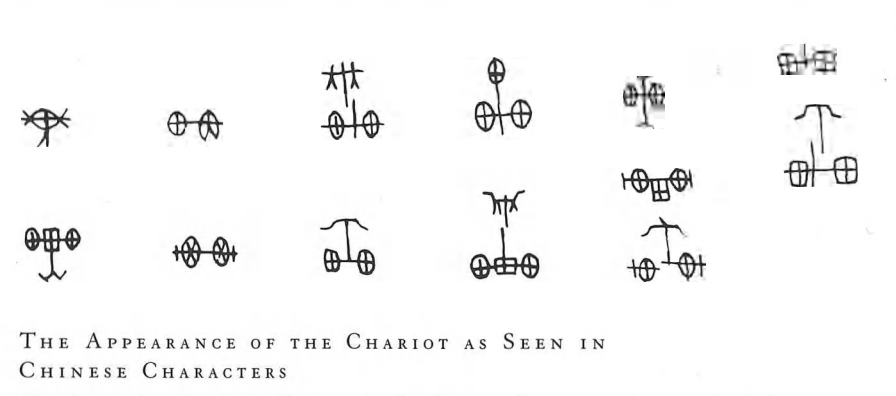
The study of the oracle-bone inscriptions involves the inscriptions; but also the study of the plastrons (exoskeletons of turtles) and scapulas (cows/oxen shoulder blades) and how they are cracked and burned. The types of animals (water buffalo, cattle and turtles) also provide information about where the Shang were scattered geographically and the phases of the Shang dynasty. The bones and shells were cleaned, leveled, smoothed, and polished before they were ready for cracking and inscriptions. The notations on the bones were more specific about their source than the inscriptions on the shells which informed historians that more bones than shells came from closer regions, which then provided information on the political economy of the Shang dynasty. The characters inscribed by the Shang on the oracle bones developed into words and over the centuries evolved into the Chinese alphabet.
Bibliography
Hansen, Valerie. “Chapter 1: The Beginnings of the Written Record”. In The Open
Empire: A History of China to 1800, 18-55. Seconded. New York: W.W. Norton &
Company, 2015. (PDF)
Keightley, David. “Chapter 1: The Oracle Bone Inscriptions of the Late Shang Dynasty”.
Sources of Chinese Tradition, Vol. 1: From Earliest Times to 1600, edited by W.
deBary et al. New York: Columbia Univ. Press, 1999. (PDF)
Keightley, David N. Sources of Shang History: The Oracle-Bone Inscriptions of Bronze
Age China. Berkeley: University of California Press, 1978.
Bensimon, Rachel. “Four-Ram Fang Zun: A Bronze Master Piece.” 2019. (MP4)
Horowitz, Joshua. “Literacy in Ancient China”. In People and Their Stuff: A History of
China in Objects Now Preserved in North America. URL:
http://scalar.tdh.bergbuilds.domains/hst137/chapter-1-the-shang-dynasty
